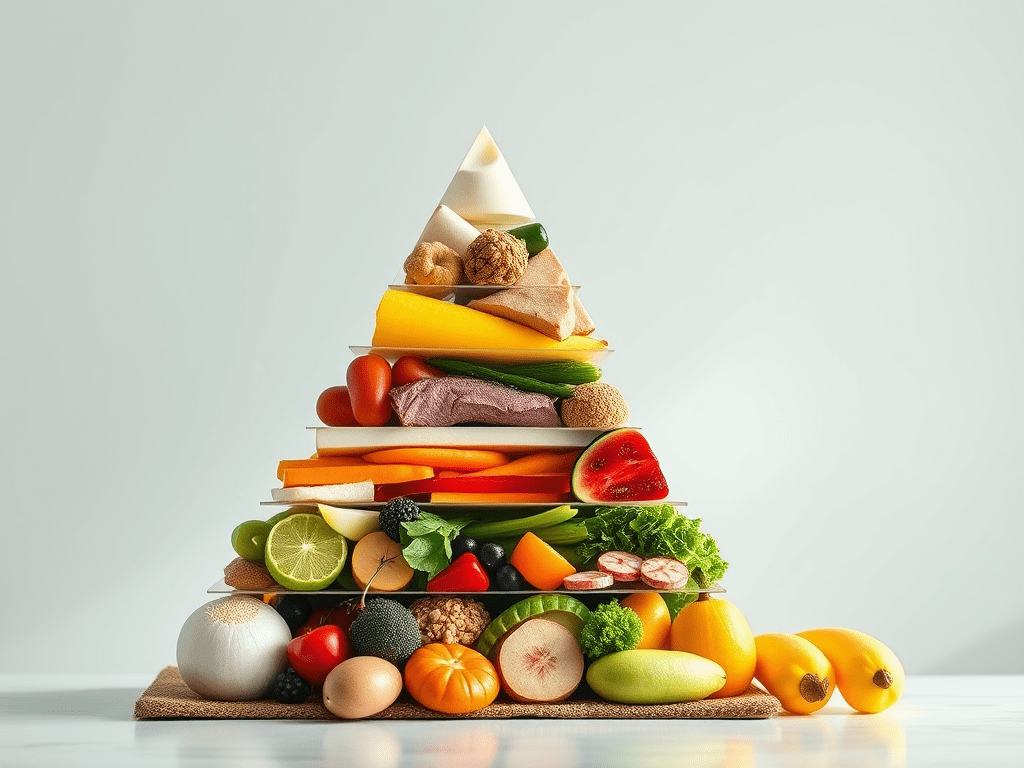
If you’ve recently seen the new upside-down food pyramid, you may be wondering if it’s time to up your intake of red meat and full-fat cheese.
As a registered dietitian, I found myself startled and confused by the new Dietary Guidelines for Americans that were recently published alongside an image of an inverted pyramid.
I realized that if I’m confused as an RD, then a lot of other people must be confused, too. This confusion is both valid and concerning.
Historically, the dietary guidelines support Americans in their food choices. However, in my opinion, the newest updates might miss the mark.
What Is the New Upside-Down Food Pyramid?
To understand the new upside-down food pyramid, it’s best to go back to the original food pyramid.
The original food pyramid was a pyramid-shaped graphic that was supposed to guide Americans on healthy eating. The pyramid placed foods that should be prioritized most in our diets at the bottom (fruits, vegetables, whole grains) and foods that should be limited or eaten sparingly at the top (processed foods). Protein foods, dairy, and healthy fats were placed in the middle of the original food pyramid.
The USDA launched the food pyramid concept back in 1992. It went through a few changes, such as adding serving sizes in 2005. However, the USDA stopped using the food pyramid in 2011 when MyPlate was introduced.
Compared to the food pyramid, MyPlate was a more intuitive approach to helping Americans eat a balanced diet. The plate featured fruits and vegetables on one half, with grains and protein on the other half. Vegetables and grains took up slightly larger portions of their halves, and dairy was placed outside of the plate as a small serving (like a glass of milk or one-ounce of cheese).
The new food pyramid (which is being referred to as the upside-down pyramid) was introduced in January 2026.
The upside-down pyramid is what it sounds like – an upside down representation of the original food pyramid, with protein foods, full-fat dairy, and vegetables featured largely at the top of the pyramid, and whole grains shown at the bottom. In between, you’ll find a few fruits, a couple of nuts, and a piece of shrimp, among other foods.
With the new, upside-down pyramid, foods at the top are recommended as priority over foods at the bottom of the pyramid. The basic concept is that the original food pyramid (which we stopped using in 2011, by the way) has now been flipped on its head.
What Changed in the New Dietary Guidelines?
The Dietary Guidelines for Americans are updated every 5 years. While changes are inevitable with each new set of guidelines, the latest changes seem more drastic than usual.
Below is a simplified table of the most notable changes to the dietary guidelines, followed by some additional explanations.
| 2020-2025 Dietary Guidelines | 2025-2030 Dietary Guidelines | |
| Graphic | A plate showing how to portion each food group – 1/2 the plate with fruits and veggies, 1/4 of the plate protein, 1/4 of the plate whole grains, dairy on the side. | An upside-down pyramid showing foods that should be eaten the most at the top and foods that should be eaten the least at the bottom. |
| Emphasized Foods | Fruits and vegetables | Vegetables, protein, full-fat dairy products |
| De-emphasized Foods | No foods were necessarily de-emphasized, but experts recommended the smallest servings of dairy | Whole grains, fruits, nuts, seeds, and other plant-based proteins and healthy fats. Fiber is also barely mentioned. |
| Written Guidelines | 164 pages of in-depth nutrition guidance. Individual nutrients are discussed thoroughly. Different people’s needs are also considered. | 10 pages of simplified nutrition guidance |
| Cooking Oils | Oils should be limited | Recommend olive oil, butter, or beef tallow when cooking |
| Protein Goals | Goals vary based on age, sex, activity levels, and health conditions. More focus on plant-based protein sources. | 1.2-1.6 g/kg body weight, but adjust as needed. More focus on animal-based protein sources. |
| Alcohol | Men should have no more than 2 alcoholic drinks per day while women should aim for 1 drink or less per day. | No specific recommendations on alcohol other than notes to “limit” intake. |
| Overall Message | Choose fruits, vegetables. whole grains, lean protein, and healthy fats. Recognize nutrition needs throughout the lifecycle, from infants to older adults. Mindfulness encouraged. | Eat whole, unprocessed, and nutrient-dense foods, especially animal protein and fats. Avoid highly processed foods. The guidelines seem stricter overall. |
The first and most obvious change to the guidelines was the graphic.
The previous 2020-2025 guidelines included a graphic of a plate with food groups portioned out in recommended servings. The new 2025-2030 guidelines include the upside-down pyramid.
MyPlate emphasized fruits and veggies the most. The new dietary guidelines emphasize protein, full-fat dairy, and veggies the most.
MyPlate provided a visual representation of servings sizes, allowing people to gauge how much of each food group they should aim to eat at each meal. The upside-down pyramid doesn’t do this and includes various foods in unequal portion sizes.
The written guidelines were also updated in the new Dietary Guidelines for Americans.
The old dietary guidelines were very long, over 100 pages. The new guidelines are drastically condensed to 10 pages. While brevity is certainly important, a lot of key information is missing, including serving sizes, calorie needs, and other important nuances of proper nutrition.
If you read the new 2025-2030 Dietary Guidelines for Americans, you may notice that there is a lot of focus on whole, nutrient-dense foods, which is great. However, you’ll also notice that the writers of the guidelines seem to think this is a novel approach. It’s not.
The old guidelines did a good job of recognizing the high costs of food and the need for food assistance benefits (like SNAP) for some Americans. This is not mentioned in the new guidelines.
Why the New Food Pyramid Is Confusing
There are many reasons why the new food pyramid is causing confusion among Americans.
It feels strange to feel confused by nutrition information as a registered dietitian. However, the issue is not that I don’t understand the guidelines, it’s that the new guidelines are contradictory and have left too much room for interpretation.
So, let’s get into the most confusing parts of the new dietary guidelines and upside-down food pyramid.
- The upside-down pyramid shape doesn’t make sense. Why is it upside-down? How is it helpful to Americans who want to improve their diets? An upside-down pyramid isn’t intuitive like previous graphics (i.e. MyPlate). There’s a reason we left the pyramid behind in 2011.
- Because of the upside-down pyramid design, there’s no guidance on portion sizes (an incredibly vital part of a balanced diet). For example, the largest images at the top of the new pyramid are an entire rotisserie chicken, a block of cheese, and one piece of broccoli. Does this mean that our protein and dairy portions should be larger than our vegetable portions?
- The new pyramid doesn’t match the written guidelines. While I appreciate that the written guidelines provide more beneficial information than the pyramid, the two seem to contradict each other a bit. Case in point, the written guidelines maintain that Americans should keep saturated fat intake to no more than 10% of total daily calories. However, if you emphasize meat, cheese, and whole milk (as suggested by the upside-down pyramid), you’ll surpass 10% every day.
- There is no strong evidence that protein and fat (especially saturated fat) should make up more of our diets than fruits, vegetables, and grains. The new guidelines have even reduced the recommended fruit and vegetable intake, putting way less emphasis on these important foods that contain essential vitamins, minerals, and fiber. Grains have been placed at the very bottom of the new pyramid, despite their importance in our diets.
- Protein is not the only macronutrient that is important. Yes, protein is incredibly important and should be included with every meal, but so should other foods. Your body needs all three macronutrients: protein, fat, and carbohydrates. A balanced meal is made up of lean protein, healthy fats (think unsaturated and omega fatty acids), vegetables, fruits, and grains (preferably whole grains). If you eat mainly protein, you’ll have a hard time meeting certain nutrient requirements.
- Fiber is only mentioned one time. Dietary fiber is found in fruits, vegetables, grains, and plant-based proteins, like nuts, seeds, and legumes. Research consistently shows that dietary fiber is an essential nutrient due to its heart health and gut health benefits, among others. Despite this, fiber is only mentioned one time in the new dietary guidelines.
- The new pyramid and guidelines leave too much room for interpretation. The general public is not versed in nutrition science (hence the importance of dietitians and nutrition scientists). Unlike previous dietary guidelines, the new guidelines do not provide clear cut nutrition recommendations. The lack of portion size guidance in the upside-down pyramid and guidelines could lead to people mistakingly eating way too much protein and not nearly enough other important foods, like fruits, vegetables, grains, and other nutrient-dense foods.
- For some reason, alcohol recommendations no longer exist. Alcohol is considered a class 1 carcinogen, meaning it is known to cause cancer in certain people, especially when used in excess. For years, experts have recommended no more than 1-2 alcoholic drinks per day depending on gender. However, these recommendations are now being ignored as Americans are being told to basically make judgment calls on alcohol intake.
There are certainly more points of confusion when it comes to the new dietary guidelines and upside-down food pyramid, but these are the most glaring to me.
Of course, you have the right and freedom to make your own food choices and completely ignore (or follow) these guidelines. However, many people look to nutrition guidelines to help them make the best food choices for their health. I worry that too many Americans will become confused by the new nutrition information (or lack thereof) available and that our health as a nation will decline even further.
Are the New Dietary Guidelines Evidence-Based?
There is plenty of evidence-based information in the new dietary guidelines. However, there are some parts of the new guidelines that aren’t supported by strong research. It also appears that evidence-based information is being disregarded in the new guidelines.
The new guidelines seem to downplay the importance of fruits, vegetables, and whole grains (foods that should be the foundation of a balanced diet). Instead, the guidelines focus heavily on protein from animal foods and full-fat food products.
While protein and fat are essential to a balanced diet, Americans don’t necessarily need to increase their intake of these foods. In fact, some evidence suggests that Americans need to consume less fat, especially saturated fat.
As previously mentioned, it’s still recommended that adults keep their saturated fat intake to no more than 10% of total calories per day. However, the new dietary guidelines seem to gloss over this important number, only mentioning it once while simultaneously highlighting full-fat dairy products and red meat (two foods that are high in saturated fat).
The new dietary guidelines are also seemingly ignoring years of research on the negative effects of alcohol consumption by removing previous intake recommendations. However, research still strongly points to alcohol as a Group 1 carcinogen, especially when consumed in excess. I’ll never forget the press conference in which Dr. Oz downplayed alcohol consumption, calling it “fun” and downplaying all the risks.
Finally (and unfortunately), these new dietary guidelines may have been written less so with research in mind and more so under the influence of certain food industries.
I won’t go into lengthy details, but will tell you this: some of the so-called experts on the dietary guidelines advisory board have close, financial ties with the dairy and beef industries.
Additional Concerns About the New Guidelines
The new 2025-2030 Dietary Guidelines for Americans aren’t all bad. There is plenty of easy-to-read, factual information in there, and many Americans may benefit from following the guidelines.
However, there are some other issues with the guidelines that you may not realize after reading the guidelines for the first time.
Here’s a quick rundown of my additional concerns with the guidelines as an RD:
- The new dietary guidelines feel more rigid than usual. I worry about people who are prone to eating disorders or disordered eating habits finding themselves feeling anxious around certain foods or additional food guilt. In the days of GLP-1s, we don’t need additional pressure on people when it comes to their nutrition.
- There is zero mention of food assistance programs. Along with this, there isn’t helpful information for people living in food deserts. This information was readily available in previous versions of the dietary guidelines.
- Sustainability and environmental impacts have gone out the window. Animal-based foods (which are the major emphasis of the new guidelines) have a large environmental impact. Unlike plant-based foods, animal products account for a large percentage land deterioration, gas emissions, water use, and other environmental impacts.
- The guidelines fail to properly define “processed foods.” It’s true that ultra-processed, like chips, desserts, and frozen meals, should be limited in your diet. However, foods like brown rice, dried beans, yogurt, eggs, and frozen fruits and veggies are also considered processed foods since they undergo minimal processing before human consumption.
A More Practical, Science-Backed Way to Eat
The thing about nutrition is it’s not as difficult as it sometimes appears.
Sure, the Dietary Guidelines for Americans are important and helpful, but do people really follow them? Probably not. Let’s be honest, you probably didn’t know the guidelines were a thing until the upside-down pyramid showed up all over social media that one day in January.
Here’s the other thing: there’s no such thing as a perfect diet. For a healthy, balanced diet, focus on patterns over perfection.
Nutrition isn’t one-size-fits-all because we all have different dietary needs. A bodybuilder and a stay-at-home mom have vastly different calorie and nutrient needs (even though both professions are equally challenging).
You can use the dietary guidelines as a jumping-off point for your diet, but don’t forget about nutrients that are hardly mentioned, like fiber. If nothing else, use the guidelines as a tool, not a rulebook.
Also, your internal hunger cues are insanely useful when it comes to knowing when to eat and when to stop eating. Mindfulness and intuitive eating are beneficial tools that can help you reconnect with your body and your hunger cues, which many of us lost years ago due to diet culture.
In terms of a practical, balanced diet, eat foods that keep you full, energized, and satisfied, and be sure to prioritize:
- Dietary fiber
- Lean protein
- Healthy fats
- Whole grains
- Fruits and vegetables
Like the guidelines say, be sure to focus on whole, minimally processed foods as much as possible. Let your plate reflect balance, not graphics.
And don’t fret if you need to feed your family frozen pizzas or McDonald’s here and there. Remember, patterns over perfection (fast food and other ultra-processed foods in moderation won’t derail your health, I promise).
Finally, I’d be remiss if I didn’t mention the importance of culture, enjoyment, and flexibility when it comes to food and eating.
Some cultural foods get looked down on because of their ingredients or how they’re prepared. However, culture is vitally important to many of our lives.
Please don’t miss out on cultural moments or pure enjoyment of food because of societal pressures or diet culture. Diet foods don’t taste good, anyway.
Final Takeaways
Overall, in my opinion as an RD, the intention of the new Dietary Guidelines for Americans was good, but the execution could have been better.
Nutrition “advice” is all over the place these days, especially thanks to social media and so-called nutrition influencers who have no business handing out advice.
As a consumer, try to pay attention to where nutrition information is coming from. Dietitians and other qualified healthcare professionals are really the only ones who should be offering nutrition advice. Your neighbor who does CrossFit and the carnivore diet probably isn’t the best source of information…
You don’t need to chase every new update to eat well.
Nutrition science is always evolving, and the next set of dietary guidelines in 5 years will probably look totally different than the current ones. However, at the end of the day, your body deserves consistency and care.
References
- https://www.dietaryguidelines.gov/sites/default/files/2021-03/Dietary_Guidelines_for_Americans-2020-2025.pdf
- https://cdn.realfood.gov/DGA.pdf
- https://myplate-prod.azureedge.us/sites/default/files/2024-05/A-Brief-History-of-the-USDA-Food-Guides.pdf
- https://pmc.ncbi.nlm.nih.gov/articles/PMC7589116/
- https://www.hhs.gov/surgeongeneral/reports-and-publications/alcohol-cancer/index.html
- https://www.frontiersin.org/journals/sustainability/articles/10.3389/frsus.2022.841106/full

 Intuitively Written